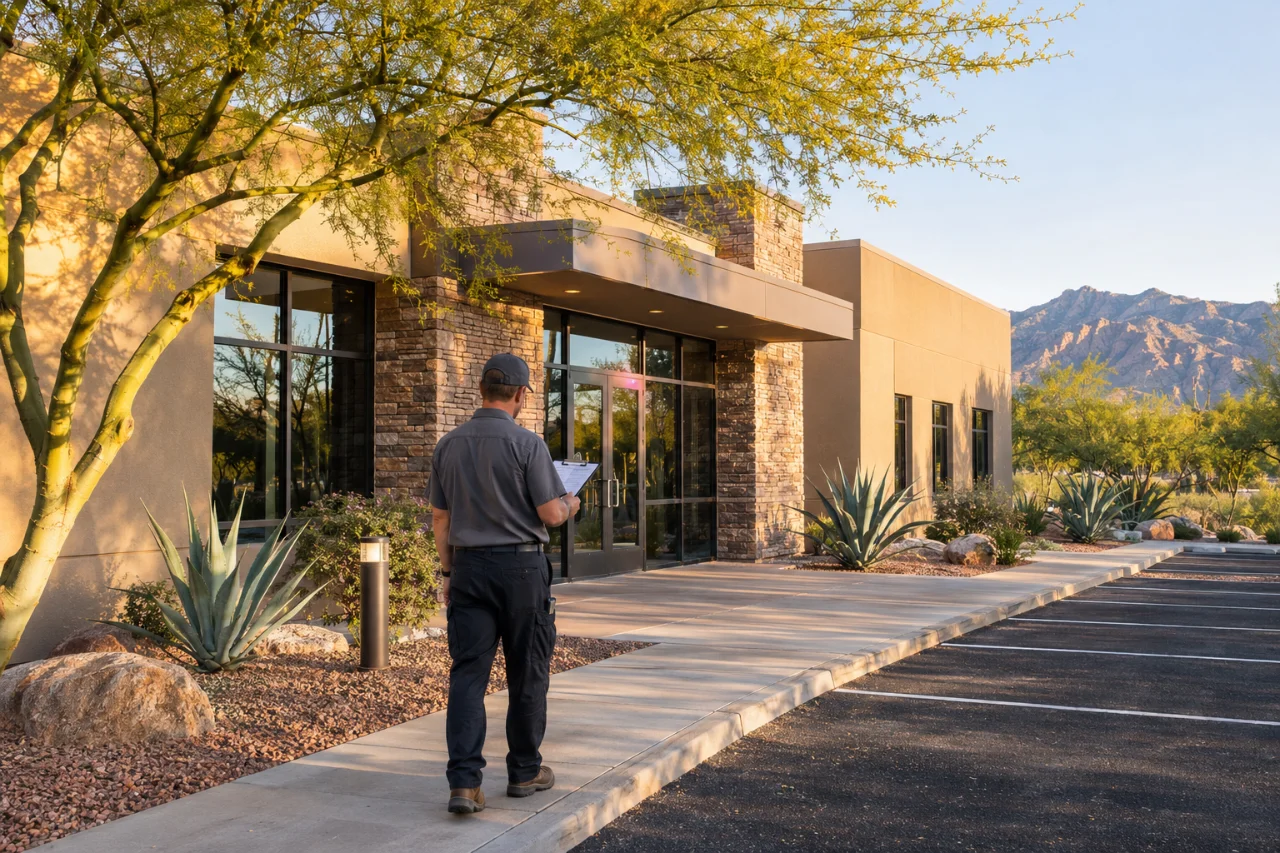
Commercial Building Maintenance Checklist for Tucson Properties
A commercial building maintenance checklist lists the inspections and upkeep tasks a property needs every day, week, month, quarter and year, plus who handles each one. In Tucson, the same list also has to follow the desert calendar: summer heat, monsoon storms, dust and a few freezing winter nights.
Most checklists you’ll find online are written for a generic building in a generic climate. They tell you to “check the HVAC” and “inspect the roof” without saying when that matters most here. This one is built for property managers in Southern Arizona. Use it as a starting point, then adjust it to your building’s age, size and tenants.
What Should a Commercial Building Maintenance Checklist Include?
A complete commercial building maintenance checklist covers every system that keeps the building safe, comfortable and open for business. Group the tasks by system first, then assign each one a frequency and an owner.
Here are the systems almost every commercial property needs on the list:
- HVAC: filters, coils, belts, condensate lines, thermostats and rooftop units.
- Plumbing: leaks, water heaters, drains, restroom fixtures and backflow devices.
- Electrical and lighting: panels, exterior and parking lot lights, exit signs and emergency lighting.
- Roof and building envelope: roof membranes, drains and scuppers, sealants, stucco, windows and doors.
- Fire and life safety: extinguishers, alarms, sprinklers and clear exit paths.
- Common areas and interiors: lobbies, restrooms, hallways, break rooms and trash.
- Exterior and grounds: parking lots, sidewalks, landscaping, irrigation, dumpster areas and graffiti.
The last group gets the least attention in most published checklists. It is also what tenants, customers and prospective buyers see first.
What Belongs on the Daily and Weekly Checklist?
Daily and weekly tasks are the quick walkthroughs that catch small problems before they turn into work orders. They take minutes, and they’re usually handled by on-site staff or a day porter.
Daily tasks
- Walk the entrances, lobby and restrooms. Restock supplies and report leaks or broken fixtures.
- Pick up litter in the parking lot, walkways and landscaped areas.
- Empty common-area trash cans and check that dumpster lids close.
- Look for new graffiti and photograph it for the removal crew.
- Confirm exit doors open freely and exit paths are clear.
Weekly tasks
- Sweep or blow off sidewalks, entries and stairwells.
- Test a sample of exterior and parking lot lights.
- Check irrigation for broken heads, puddling and dry spots.
- Clean glass at main entrances and wipe down high-touch surfaces.
- Review open work orders and close out anything that’s finished.
On busy retail or medical properties, the daily list is often a full-time job. That’s where day porter services in Tucson earn their cost: one person on site keeps common areas clean and reports issues the same day.
What Should You Check Monthly and Quarterly?
Monthly and quarterly tasks keep equipment running and inspections on schedule. They need a bit more skill, so plan them with your maintenance team or contractors.
Monthly tasks
- Visually inspect every portable fire extinguisher and initial the tag.
- Check HVAC filters. During dust storm season, replace them more often than the manufacturer’s schedule suggests.
- Inspect restroom plumbing, water heaters and visible pipes for leaks or corrosion.
- Test emergency lighting and exit signs.
- Sweep the parking lot on a set schedule and note potholes, cracks and faded striping.
The monthly extinguisher check isn’t optional for employers. OSHA’s portable fire extinguisher standard states that “portable extinguishers or hose used in lieu thereof under paragraph (d)(3) of this section shall be visually inspected monthly,” and it also requires “an annual maintenance check” (OSHA 29 CFR 1910.157). Keep the records, because inspectors and insurers ask for them.
Quarterly tasks
- Service HVAC units: clean coils, check belts and flush condensate lines.
- Inspect the roof, roof drains and scuppers, especially after storms.
- Check sealants around windows, doors and roof penetrations. Arizona sun breaks them down faster than you’d expect.
- Walk the exterior for stucco cracks, peeling paint and pest entry points.
- Review the landscape plan: pruning, irrigation timing and plant replacements.
Which Tasks Happen Once or Twice a Year?
Annual and semiannual tasks are the larger inspections and cleanings that protect the building’s value. Schedule them in the season when they do the most good and cause the least disruption.
- Annual fire extinguisher maintenance and fire alarm and sprinkler inspections by licensed technicians.
- Backflow assembly testing on the schedule your water provider requires. Keep the test reports on file.
- Full HVAC service before summer, when cooling demand peaks.
- Pressure washing of sidewalks, entries, dumpster pads and building exteriors. See how often a commercial building should be pressure washed.
- Parking lot assessment: seal coating, crack filling and restriping as needed.
- Electrical inspection of panels and connections by a licensed electrician.
- Budget review: compare last year’s repairs against the plan and adjust for next year.
How Does Tucson’s Climate Change the Maintenance Calendar?
Tucson’s climate decides when most tasks should happen. Heat, monsoon storms, dust and the occasional hard freeze each put a different system under stress, so the same checklist needs different priorities in different months.
| Season in Tucson | What stresses the building | Checklist priorities |
|---|---|---|
| Spring (March to May) | Rising heat, pollen, mesquite pods and palo verde blossoms | Full HVAC service before summer, roof and sealant inspection, irrigation tune-up, extra parking lot sweeping |
| Early summer (late May to June) | Peak heat and UV, dry winds | Filter changes, rooftop unit checks, shade and lighting checks, watch for cracked sealants and stucco |
| Monsoon (about July to September) | Heavy rain, flooding, dust storms, wind and lightning | Clear roof drains and scuppers before storms, inspect after each major storm, sweep debris out of lots and storm drains, check for roof leaks and water stains |
| Fall (October to November) | Cooler weather, storm cleanup | Repair storm damage, pressure wash exteriors, pruning, seal coating and restriping while temperatures are mild |
| Winter (December to February) | Occasional freezing nights, winter visitors and heavier retail traffic | Protect exposed pipes and backflow devices, adjust irrigation, keep entries and lots clean for peak traffic |
The National Weather Service office in Tucson notes that the monsoon “typically arrives in mid to late June over northwest Mexico, and early July over the southwest U.S.” That makes June the deadline for roof drains, gutters and lot sweeping. Clearing a roof drain in May costs a fraction of a ceiling repair in August.
Dust is the other local factor generic checklists miss. Dust storms pack HVAC filters, coat solar panels and windows, and wash fine grit into parking lots and drains. Plan for more filter changes and more sweeping from July through September.
Who Should Handle Each Task: Your Team or a Contractor?
Split the checklist by skill and risk. On-site staff can handle walkthroughs and light cleaning. Licensed contractors should handle regulated systems. Specialized crews with the right equipment are the most efficient choice for exterior work.
| Task | On-site staff or day porter | Licensed or specialized contractor |
|---|---|---|
| Daily walkthroughs, litter, restroom checks | Yes | Not needed |
| Monthly extinguisher visual check | Yes, if trained | Annual maintenance check |
| HVAC filters | Sometimes | Coil cleaning, refrigerant, rooftop units |
| Plumbing leaks and fixtures | Report and minor fixes | Repairs, water heaters, backflow testing |
| Electrical and lighting | Report outages | Panels, wiring, new fixtures |
| Parking lot sweeping | Spot cleanup | Scheduled sweeping with a lot sweeper |
| Pressure washing | No | Sidewalks, entries, dumpster pads, walls |
| Graffiti removal | Report and photograph | Removal and surface-matched repainting |
| Landscaping and irrigation | Report issues | Pruning, irrigation repair, desert plant care |
The more vendors you manage, the more time goes into scheduling and chasing invoices. Many Tucson property managers cut that down by giving the whole exterior and common-area list to one company. CAMCO’s commercial building maintenance in Tucson combines HVAC, plumbing and electrical work through licensed partners with parking lot sweeping, commercial pressure washing, graffiti removal and landscape maintenance under one contract.
How Do You Build a Preventive Maintenance Checklist for Commercial Buildings?
Start with an inventory, then turn it into a schedule. A preventive maintenance checklist for commercial buildings works only when every task has a frequency, an owner and a place to record that it was done.
- List every system and asset. Walk the building and note each HVAC unit, water heater, panel, roof section and exterior area.
- Pull the requirements. Manufacturer schedules, your insurance policy, lease obligations, fire code and water provider rules all set minimums.
- Assign a frequency to every task. Use the daily, weekly, monthly, quarterly and annual groups above.
- Assign an owner. Name a person or a vendor, not just “maintenance.”
- Add the Tucson calendar. Move roof, drain and HVAC work ahead of summer and the monsoon.
- Record everything. Dates, photos and invoices protect you in insurance claims and tenant disputes.
- Review it every year. If the same repair keeps coming back, change the frequency or the vendor.
Keep it simple. A shared spreadsheet that people actually update beats a complex system nobody opens.
What Does Skipping the Checklist Cost?
Skipped maintenance rarely costs nothing. It costs more later. A clogged roof drain can turn one storm into a ceiling and flooring repair. A dirty HVAC coil makes the unit run longer in July, and that shows up on the power bill. A parking lot that isn’t swept holds grit, oil and trash that wear the asphalt and wash into storm drains.
There’s a tenant cost too. Overflowing trash, graffiti left for weeks and dark parking lots tell tenants and their customers that no one is watching the property. That makes lease renewals harder. Our post on signs your parking lot needs maintenance covers the early warnings, and our guide to how fast graffiti should be removed explains why speed matters.
If you’re pricing the exterior part of the list, our breakdown of parking lot sweeping cost in Tucson and our guide to how often to sweep a parking lot help you budget for it.
Frequently Asked Questions
How often should a commercial building be inspected?
Walk the common areas daily and run a fuller system check monthly. Bring in licensed technicians quarterly for HVAC, and at least once a year for fire protection, electrical and plumbing. Older buildings and high-traffic retail sites usually need shorter intervals.
What is the difference between a building maintenance checklist and a preventive maintenance plan?
A building maintenance checklist is the task list. A preventive maintenance plan adds the schedule, owners, budget and records that make sure the list gets done before things break. Use the checklist as the backbone of the plan.
Who is responsible for maintenance in a commercial lease?
It depends on the lease. In many multi-tenant properties, the landlord maintains common areas and charges tenants a share through common area maintenance (CAM) fees, while tenants handle their own suites. Read the maintenance and CAM sections of each lease before you assign tasks.
Is a commercial property maintenance checklist different for retail, office and HOA properties?
The systems are similar, but the priorities shift. Retail centers need more parking lot sweeping, litter pickup and graffiti response. Offices lean on HVAC and restroom upkeep. HOAs focus on landscaping, common areas and lighting. Start from the same commercial property maintenance checklist and weight it to your property type.
When should Tucson properties schedule roof and drain work?
Schedule it in spring, and finish it by June. The monsoon usually reaches Southern Arizona in early July, and clogged drains and worn sealants are the most common sources of storm leaks. Inspect again after each major storm.
Want One Team to Handle Your Checklist?
CAMCO keeps Tucson commercial properties on schedule: building maintenance, day portering, parking lot sweeping, pressure washing, graffiti removal and landscape maintenance from one local company. Send us your property details and we’ll suggest a schedule that fits your building and budget. Request a free maintenance quote or call 520-748-2583.